
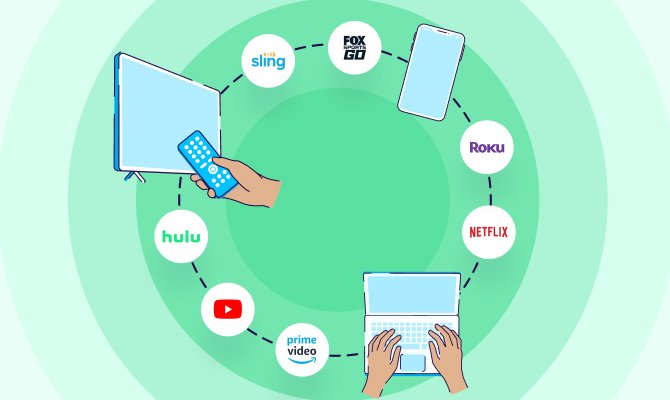
An over-the-top (OTT) application is a platform that delivers video, audio, or digital content directly to users over the internet — with no cable provider, broadcaster, or satellite dish in between. Netflix, Spotify, and Apple TV+ are mainstream examples. For sports clubs, media brands, and community organisations, white-label OTT apps let you own your audience and content entirely. OverTheTop.app makes it possible to launch your own branded app for $249 per month, with no development agency or upfront build cost required.
If you have ever watched a game on a club’s own app, listened to a podcast on a platform your favourite creator built, or paid a monthly fee to access a league’s exclusive content — you have used an over-the-top application.
The term sounds technical, but the idea is simple: OTT apps go “over the top” of traditional gatekeepers like cable networks and broadcast TV to put content and audience ownership directly in the hands of the publisher.
This guide breaks down exactly how OTT applications work, what they cost to build, and why organisations of every size are making the move in 2026.
How does an over-the-top application work?
An OTT application sits between your content library and your audience. Instead of needing a cable subscription or a TV broadcast deal to reach viewers, you upload content to a platform, and your audience accesses it through an app on any internet-connected device — smartphone, smart TV, tablet, or browser.
The delivery chain looks like this:
| Stage | What happens |
|---|---|
| Content upload | Video, audio, or live stream is ingested and encoded |
| Content delivery network (CDN) | File is distributed to servers close to the viewer’s location |
| App layer | The viewer opens your branded app and the content streams in |
| Paywall / access control | You decide who can watch: free, subscription, pay-per-view, or members-only |
The key difference from a YouTube channel or a Facebook Live stream is ownership. On an OTT platform, you own the subscriber data, control the monetisation, and are not subject to algorithm changes or platform policy updates.
What are the main types of OTT applications?
Not all OTT apps are the same. The three most common models are:
Subscription video on demand (SVOD) Users pay a recurring fee — monthly or annually — for unlimited access to a content library. Netflix and Disney+ run this model. Sports clubs use it for season passes and training video libraries.
Transactional video on demand (TVOD) Users pay per item — a single game, event, or course. Common for one-off pay-per-view events, fight nights, and premium workshops.
Ad-supported video on demand (AVOD) Content is free to the viewer, funded by advertising. Less common for niche publishers and sports organisations, where audience loyalty makes subscription models more valuable.
Most white-label OTT platforms — including OverTheTop.app — support all three models simultaneously, so you can mix free content with paid tiers.
Who is building OTT applications in 2026?
The mainstream narrative around OTT is dominated by Netflix and Spotify, but the fastest growth in 2026 is happening at the community and niche level:
- Sports clubs and leagues — building member apps to deliver match replays, coach content, and live coverage without paying a broadcast fee
- Faith organisations — replacing in-person attendance drop-off with on-demand sermon libraries and live-streamed services
- Fitness and wellness creators — moving paying members off YouTube and onto owned platforms with subscription billing
- Regional media companies — replacing dying print revenue with video subscription products
The economics have shifted. Building a functional OTT app no longer requires a six-figure development budget. White-label platforms now let organisations launch in weeks, not months, with full branding and monetisation from day one.
How is an OTT app different from a streaming website?
A common question. The short answer: OTT apps are native, branded, and built for distribution.
| OTT app | Streaming website |
|---|---|
| Available on iOS, Android, smart TV app stores | Browser-only |
| Push notification access | No direct user notification |
| App store discoverability | Not discoverable outside Google |
| Offline viewing (where enabled) | Requires active connection |
| Subscription billing via app stores or Stripe | Requires custom payment setup |
For most publishers, having both is the right move — a website for discovery, an app for retention.
What does it cost to build an OTT application?
Costs vary widely depending on whether you build from scratch or use a white-label platform.
Custom build: A fully custom OTT app — iOS, Android, and web — with a CMS, video player, and subscription billing typically costs between $80,000 and $250,000+ to build, plus ongoing engineering maintenance. Factor in ongoing developer fees to maintain, update, and fix the app and the total year-one cost rarely comes in under six figures. This path makes sense for large media companies with deeply specific requirements and a dedicated technical team.
White-label platform: This is where the economics have fundamentally changed for smaller organisations. OverTheTop.app gives you a fully branded, multi-platform OTT app — iOS, Android, Apple TV, and web — for $249 per month. No development agency. No six-figure upfront cost. No engineering team on payroll.
That $249 covers your app infrastructure, content management, video delivery, and subscription billing tools. A club or creator that signs up 50 paying members at $10 per month covers the platform cost entirely in the first month.
| Custom build | OverTheTop.app | |
|---|---|---|
| Upfront cost | $80,000 to $250,000+ | $0 |
| Monthly cost | Engineering retainer ($3,000+) | $249 |
| Time to launch | 3 to 12 months | 2 to 4 weeks |
| Branded iOS + Android app | Yes | Yes |
| You own the subscriber data | Yes | Yes |
| Ongoing maintenance required | Yes (your team) | Included |
| CDN / video hosting costs | Yes (additional) | Included via OTT 2.0 architecture |
For most sports clubs, faith organisations, and independent media brands, the white-label route is not a compromise — it is the smarter commercial decision.
For a detailed breakdown of what sports club apps cost at different tiers, see: How Much Does It Cost to Build a Sports Club App.
FAQ
What does “over the top” mean in technology? “Over the top” refers to delivering content over the public internet rather than through a traditional broadcast or cable infrastructure. The phrase describes going “over the top” of the traditional gatekeepers — networks, cable providers, and satellite operators — to reach audiences directly.
Is Netflix an over-the-top application? Yes. Netflix is the most well-known example of an OTT application. It delivers video content directly to users over the internet, with no requirement for a cable subscription or broadcast receiver. Disney+, Spotify, Apple TV+, and HBO Max are all OTT applications.
Can a small organisation build its own OTT app? Yes — and it is more affordable than most people expect. OverTheTop.app lets sports clubs, churches, fitness brands, and independent creators launch a fully branded app on iOS, Android, and smart TVs for $249 per month. There is no development agency required, no upfront build cost, and no engineering team to hire. If your audience values your content enough to pay even a small subscription fee, the platform pays for itself quickly. [Get started here].
What devices do OTT apps run on? OTT apps can be built for iOS, Android, Apple TV, Android TV, Fire TV, Roku, Samsung Smart TV, and web browsers. Most white-label platforms support multi-device publishing from a single content management system.
How do OTT apps make money? The three primary monetisation models are subscriptions (recurring monthly or annual fee), pay-per-view (single purchase per event or piece of content), and advertising (free content supported by ad revenue). Most platforms support a combination of all three.
What is the difference between OTT and IPTV? OTT delivers content over the open public internet and does not require a specific internet service provider. IPTV (Internet Protocol Television) is delivered over a closed, managed network — typically controlled by a broadband provider — with more consistent quality but less flexibility for publishers.
Do I need a content delivery network (CDN) for an OTT app? With most platforms, yes — and it adds meaningful cost and complexity. A traditional CDN licenses server infrastructure to distribute your video files globally, which is an ongoing expense on top of your platform fee. OverTheTop.app takes a different approach entirely. Our OTT 2.0 architecture uses social platforms like YouTube and Vimeo as the delivery layer for archived and live content. Your footage is hosted there, streamed inside your branded app at no additional infrastructure cost, and simultaneously earns ad revenue on those platforms while boosting your trending analytics across your social channels. You get professional-grade video delivery, a second monetisation stream, and a wider discovery footprint — without paying for a CDN.
Related Content
- Why Sports Clubs Need Their Own OTT App — The case for clubs taking control of their content and audience
- How Much Does It Cost to Build a Sports Club App — A breakdown of build costs at different tiers
- Get Started with OverTheTop.app — Launch your own branded OTT app